Demand family map
High-running tools are grouped by machine, material, part family and annual usage so replenishment risk is visible.
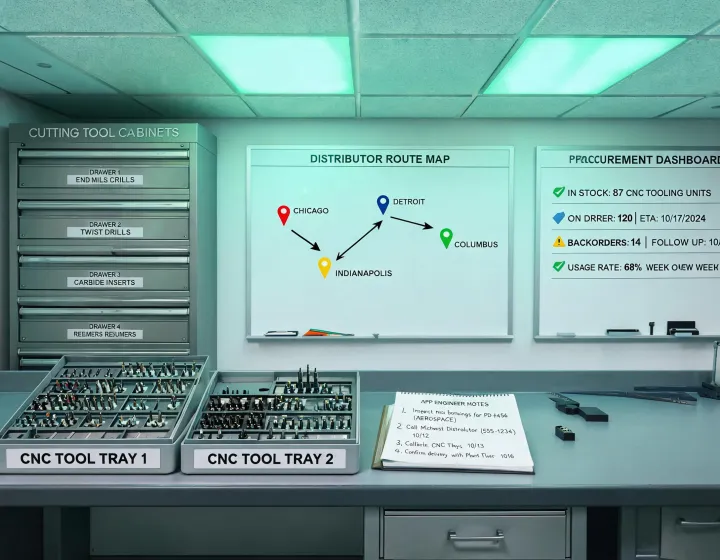
High-running tools are grouped by machine, material, part family and annual usage so replenishment risk is visible.
Each plant has a local route for normal orders, urgent service and application engineering escalation.
Backup products are reviewed before a shortage, with quality and engineering signoff attached to the sourcing record.
Usage, cost movement, shortage incidents and tooling performance are reviewed on a recurring schedule.
Catalog references, certificate expectations and substitution notes remain accessible for audit or customer review.
Procurement, production and quality teams know which contact owns each type of problem.
The first review does not need to solve every tooling problem. It should build a usable baseline that allows buyers to distinguish normal replenishment from technical exceptions.
The team captures high-running product families, current suppliers, usage, open shortages and affected machines.
Each item is ranked by lead time, line impact, audit sensitivity, substitution difficulty and service dependency.
Normal orders, technical questions, document requests and urgent issues get clear owners and response paths.
Quarterly check-ins track usage, missed deliveries, tool-life feedback, document gaps and opportunities to simplify.
Share the plant list, current tool families and service regions. Sandvik Coromant can help turn scattered buying into a documented support network.